

NT Scan FAQs: 50 Common Questions About Timing, Measurements, Results and Pregnancy Screening
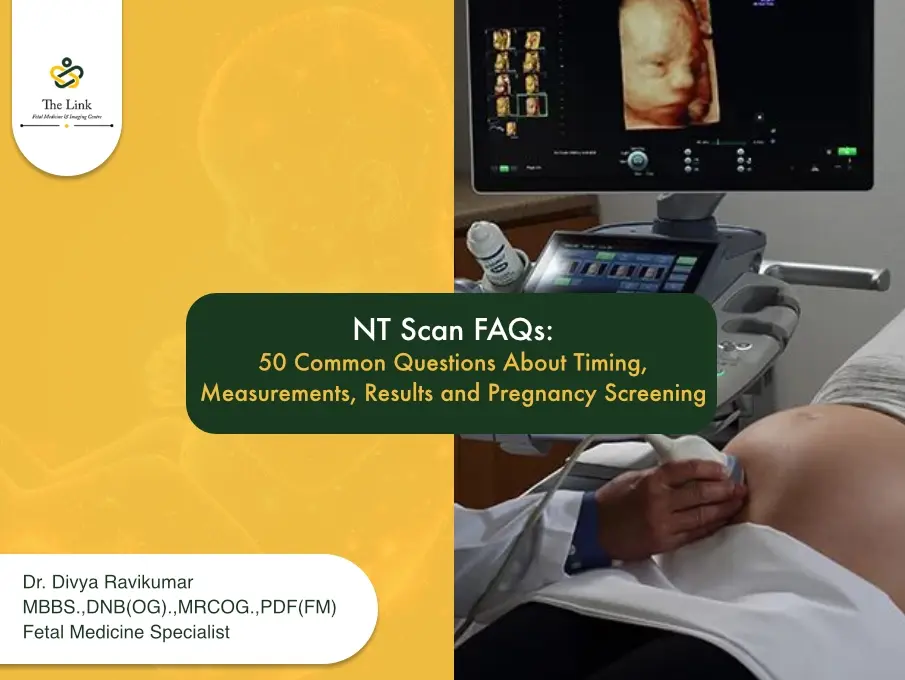
An NT scan, or nuchal translucency scan, is an ultrasound performed during the first trimester to measure the fluid-filled space at the back of a baby's neck. It is usually offered between 11 weeks and 13 weeks + 6 days of pregnancy and helps assess the chance of certain chromosomal conditions, including Down syndrome.
For parents searching for an NT scan in Chennai, understanding the scan's timing, measurements and results can make the screening process less confusing. The answers below address common questions about the procedure and explain what may happen if the result indicates an increased chance of a condition.
Important: An NT scan is a screening assessment, not a diagnostic test. A measurement alone cannot confirm whether a baby has a chromosomal or structural condition.
50 Common Questions About NT Scans
A. Timing and preparation
What does NT stand for? Nuchal translucency, the fluid-filled space behind the baby's neck.
When is an NT scan performed? Usually between 11 weeks and 13 weeks + 6 days.
Can I have it at 10 weeks? Usually not for a standard NT measurement; the baby may be too small.
Can I have it after 14 weeks? The standard NT screening window will generally have passed.
What is the ideal time? Your specialist can advise based on gestational age and crown–rump length.
What is crown–rump length (CRL)? The measurement from the top of the baby's head to the bottom of the torso.
Does the scan require fasting? Usually not, but follow the centre's instructions.
Should I drink water beforehand? Ask the scan centre; bladder requirements depend on the examination.
How long does it take? It varies depending on the baby's position and the views required.
Can I bring my partner? Check the centre's visitor policy.
B. Understanding the scan
How is an NT scan performed? Usually through an abdominal ultrasound; a transvaginal scan may occasionally be considered.
Is it painful? No. Ultrasound is generally painless, although mild pressure may be felt.
Is it safe? Diagnostic ultrasound is widely used in pregnancy when performed appropriately by trained professionals.
Does it use radiation? No. Ultrasound uses sound waves.
What does the scan examine? NT thickness, CRL and selected early fetal anatomical features.
Is it the same as a dating scan? Not exactly. A first-trimester scan can assess dating as well as NT.
Can it detect twins? Yes. It can help identify the number of babies and assess the type of twin pregnancy.
Can it check the heartbeat? Yes, fetal cardiac activity is usually assessed.
Can it identify every birth defect? No. Some conditions develop later or cannot be seen on ultrasound.
Does it replace the anomaly scan? No. The second-trimester detailed anomaly scan is still important.
C. NT measurements
What is a normal NT measurement? It depends on the baby's CRL and the relevant reference range.
Is 1.5 mm normal? It is often within the expected range, but the report must be interpreted in context.
Is 2.5 mm normal? It may be within the expected range for some CRL measurements; individual assessment matters.
Is 3 mm concerning? It may need interpretation against gestational age, CRL and the screening protocol.
What does NT above 3.5 mm mean? It is commonly considered increased and usually warrants further assessment.
Does increased NT mean Down syndrome? No. It indicates an increased chance of certain conditions, not a diagnosis.
Why is NT measured carefully? Fetal position and image quality can affect the measurement.
Does the baby's position matter? Yes. The neck should be in a neutral position for accurate measurement.
Can the measurement change? NT changes with fetal growth and gestational age.
Can the scan be repeated? Sometimes, if the first images are not adequate and the pregnancy remains within the screening window.
D. Results and further testing
What is a low-risk result? It means screening estimates a lower chance of the conditions assessed.
What is a high-risk result? It indicates a higher estimated chance and may lead to further counselling or testing.
Does a normal NT guarantee a healthy baby? No. It cannot exclude all chromosomal or structural conditions.
What is combined first-trimester screening? It combines NT measurement with maternal blood markers and other factors to estimate risk.
What is NIPT? A blood test that analyses cell-free DNA to screen for selected chromosomal conditions.
Is NIPT diagnostic? No. It is a screening test, even though it has high detection performance for common trisomies.
What happens after a high-risk result? A specialist may discuss genetic counselling, additional ultrasound and diagnostic testing.
What is CVS? Chorionic villus sampling, a diagnostic test using a small placental tissue sample.
What is amniocentesis? A diagnostic procedure that tests a sample of amniotic fluid.
Can I decline further testing? Yes. Your options should be explained so you can make an informed decision.
E. Other practical questions
Does maternal age affect screening? Age may be included in some risk calculations, but screening options should be discussed with all pregnant patients.
Is NT screening useful after IVF? It may be offered in IVF pregnancies just as in other pregnancies.
Is it needed for every pregnancy? Screening choices should be discussed with your obstetrician; individual preferences and circumstances matter.
Can an increased NT resolve later? The fluid measurement may change, but follow-up is still important when it is increased.
Can increased NT be associated with heart conditions? Yes, it can be associated with some structural conditions, including congenital heart defects.
Will I need a fetal echocardiogram? It may be recommended depending on the NT measurement and other findings.
Will I need a detailed anomaly scan? Yes, the routine second-trimester scan remains important; additional targeted imaging may also be advised.
When will I receive the report? Many centres provide an ultrasound report on the same day, but timing varies.
What should I bring to the appointment? Previous scan reports, pregnancy records and relevant blood-test or screening results.
Where can I get an NT scan in Chennai? Choose a centre with appropriately trained ultrasound professionals and access to specialist counselling when needed.
Why Is Specialist Interpretation Important?
NT measurements should be taken using standardised ultrasound technique and interpreted alongside the baby's CRL, gestational age and other screening information. ISUOG recommends a precise mid-sagittal image, neutral fetal position and appropriate magnification for measurement.
If the NT is increased, the next step is not to assume that the baby has a condition. Your doctor may discuss genetic counselling, screening choices or diagnostic tests such as CVS and amniocentesis. A detailed ultrasound assessment, usually around 18–22 weeks, is also important.
Conclusion
An NT scan is an important first-trimester screening examination that helps assess the chance of selected chromosomal conditions and provides an early look at fetal development. The timing, measurement technique and interpretation all matter. A result should always be considered alongside other screening information and the pregnancy history.
If you are planning an NT scan in Chennai, speak with a fetal medicine specialist about the appropriate scan window, what the measurement means and whether any additional screening is suitable for your pregnancy.
Doctor’s Note
At The Link Fetal Medicine and Imaging Center, Dr. Divya Ravikumar provides fetal assessment, prenatal screening and counselling to help parents understand scan findings and available options. Every screening result should be interpreted individually, with clear explanations and evidence-based guidance.
— Dr. Divya Ravikumar, MBBS, DNB (OG), MRCOG, PDF (Fetal Medicine), Fetal Medicine Specialist
FAQs
1. What is the best week for an NT scan?
The NT scan is generally performed between 11 weeks and 13 weeks + 6 days, when the CRL is usually between 45 mm and 84 mm.
2. What NT measurement is considered high?
An NT measurement around 3.5 mm or above is commonly treated as increased. However, interpretation depends on CRL, gestational age and the clinical protocol.
3. Does an increased NT always mean a chromosomal abnormality?
No. Increased NT can be associated with chromosomal, genetic or structural conditions, but it can also occur in babies without an identified condition.
4. Is an NT scan and NIPT the same test?
No. NT is measured by ultrasound, while NIPT is a maternal blood test that analyses cell-free DNA. Both are screening methods, not diagnostic tests.
5. What should I do if my NT scan result is high risk?
Discuss the report with your obstetrician or fetal medicine specialist. They can explain the result and discuss whether genetic counselling, further screening, diagnostic testing or detailed ultrasound is appropriate.
References


Comments